AI-native design orchestrator
Design as an agentic pipeline
not a prompt
My role
Design lead. I led DesignX from an npm package experiment to enterprise delivery: the pipeline and its gates, a team of 15+ contributors and every screen of the product, designed and built myself.
Used in enterprise delivery by EPAM designers working for
- In
- a regulated fintech brief
- Agents
- 11
- Phases
- 6
- Out
- a design system of record
01 · The gap
AI made design faster and impossible to defend.
By 2026 generative tools could produce a screen in seconds. The market split into two camps, and neither one produced the thing a senior team actually needs.
One-shot generators
v0, Lovable, Figma AI. A screen in seconds, with no research lineage and no rationale, and they will invent facts to fill the gaps.
Copilots
Genuinely useful for one artefact at a time. But what to make, in what order, gated by what: all of that still lives in your head.
A system of record
Nothing produced a durable chain: the artefact, the insight beneath it and the evidence beneath that. Output without lineage.
Undefendable work
A team cannot ship what it cannot defend in a review. Speed that produces unciteable work is not speed.
02 · The bet
What if design ran like a production line?
Not a prompt you fire and hope. A governed pipeline: distinct phases, specialised agents, hard approval gates and an evidence contract where nothing ships unsourced.
03 · My role
I owned the line, from strategy to the last pixel.
Depth of ownership across six areas
- Co-led1
- Orchestration and control modelRun modes, autonomy levels, model routing and context budgets.
- Led3
- Product strategy and pipeline shapeThe six phases, the nine gates and the reframe from prompt to production line.
- Agent and skill definitions11 agents across 13 categories, plus the protocol every agent inherits.
- The quality barA 482-line design authority that grades every visual output and the eval harness that enforces it.
- Sole2
- Token optimisationAppropriate model used per task with BYOK, Ollama and LM Studio support built in.
- The entire product UXEvery screen in this case study. Design and build, start to finish.
Four areas led · two owned outright
Leading the team
Most of the 15+ people I led did not report to me.
15+ contributors, their own projects
Contributors from across EPAM, each working on their own projects alongside DesignX. A couple reported to me; most did not.
Alternate-day stand-ups
Weekly critiques and async channels kept the work moving between them.
Milestone demos
Progress shown to stakeholders at each milestone and at the quarterly design all-hands.
One pipeline, two disciplines
Worked with engineering teams to route contributions into EPAM’s agentic delivery pipelines.
I ran the team the way the pipeline runs: work comes in, gets reviewed against a bar and only then merges.
04 · The pipeline
Six phases. Multiple gates. Nothing skips.
A phase cannot advance until its gate clears and a human decides when it does.
- Phase 00 · Gate DSG00
Onboard
Three calm questions and a knowledge-base upload. Name it, pick a run mode, drop in what you already know. Everything the pipeline needs, before any generation happens.
- Phase 01 · Gate D101
Discover
Agents read the uploaded corpus and produce insights with evidence IDs and confidence levels attached. Nothing is asserted without a citation back to a source in the knowledge base.
- Phase 02 · Gate D202
Ideate
Concepts are generated against the insights, then scored against a requirements checklist. Unmet requirements and blockers are on the table before the gate opens.
- Phase 03 · Gate VDG03
Design
A design system of record is produced first: tokens, components, states. Screens are then specified against it, and a Design Director pass reviews visual quality before anything is called done.
- Phase 04 · Gate D304
Deliver
The Builder turns the design system and screen specs into real, running code, opened in a live preview beside the conversation. Spec and product stay in the same window.
- Phase 05 · Gates R1 to R405
Measure
A designer-QA rubric scores the output across eight dimensions and names every gap it finds so each one can be resolved to a production spec.
04 · The pipeline
Six phases. Multiple gates. Nothing skips.
A phase cannot advance until its gate clears and a human decides when it does.
Hover or focus a phase to open it
05 · Progressive disclosure
Hiding a studio behind three questions.
The hardest design problem was not the machinery. It was making the machinery feel like nothing. Every one of the agents and skills stays invisible until the moment it is needed.
- New project · GreenBasket (demo only)
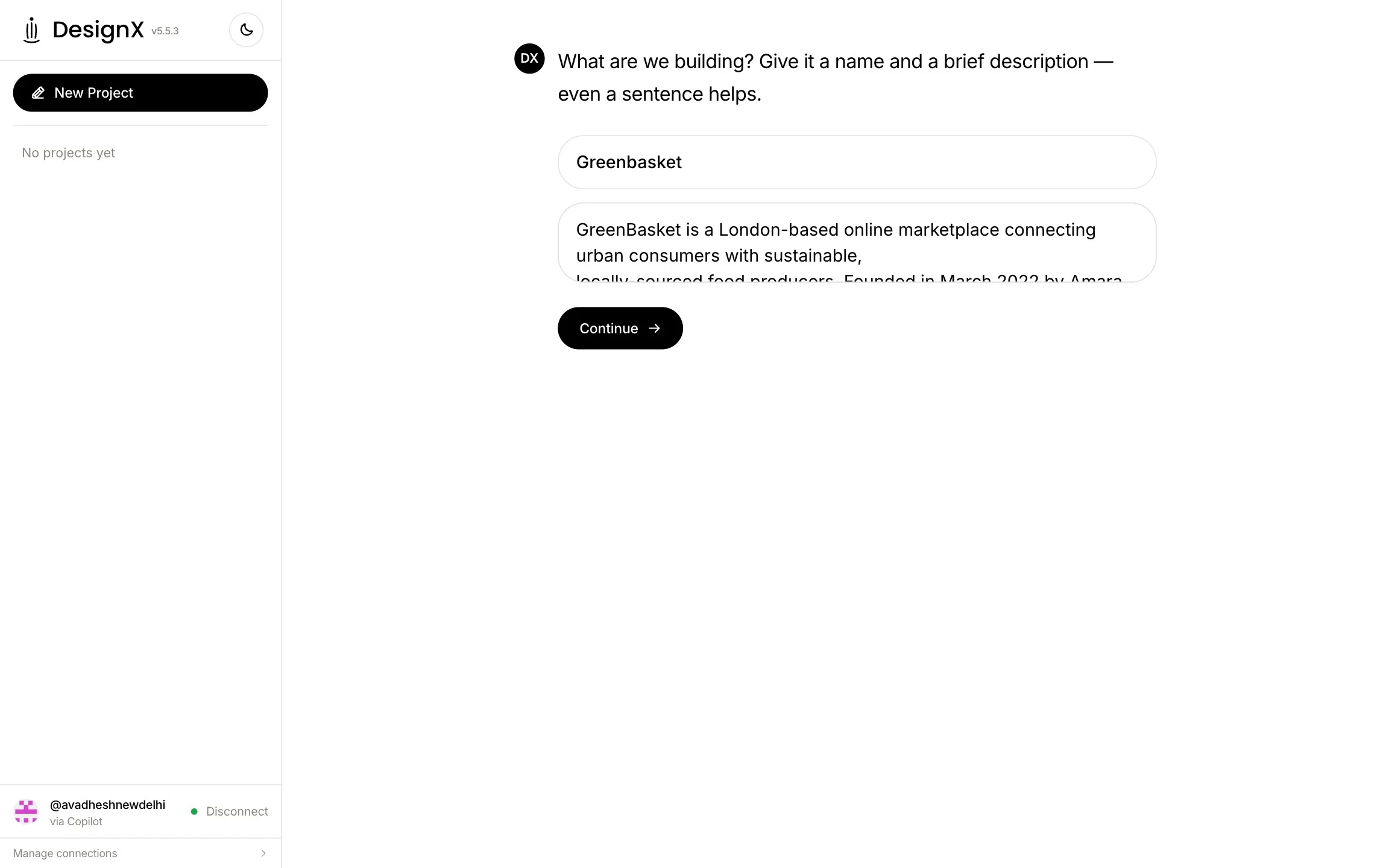
GreenBasket · Test project
A fictional London grocery marketplace, set up to demo the pipeline end to end for the purpose of this case study.
GreenBasket · Test project
A fictional London grocery marketplace, set up to demo the pipeline end to end for the purpose of this case study.
DesignX started as a directory you worked in from VS Code, which suited developers more than designers. I pushed for an app designers would actually open, led it and onboarded them myself: demos for most and workshops for those who preferred to stay in VS Code.
06 · Control
Autonomy is a dial, not a switch.
Trusting a pipeline is not all-or-nothing. Four run modes move the same pipeline along a single axis: how often it stops and asks you. The gates never disappear; they only change who opens them.
Gate behaviour
Phase boundaries pause
When you reach for it: The default.
Barred = pauses for you · Hollow = clears itself
Control is only half of trust. The other half is proof.
07 · Traceability
Every pixel can name its source.
GreenBasket is a fictional London grocery marketplace, set up to test the pipeline. One of its screens, traced backwards to the survey row it came from.
- Stage 1 of 4 · Evidence · E22 · E36
Two rows in a survey
Consumer survey data and a user transcript. GreenPass converts at 26.3% against a 35% target. Tom, a subscriber, is unsure whether the membership saves him money on this specific order.
Artefact · E22 · E36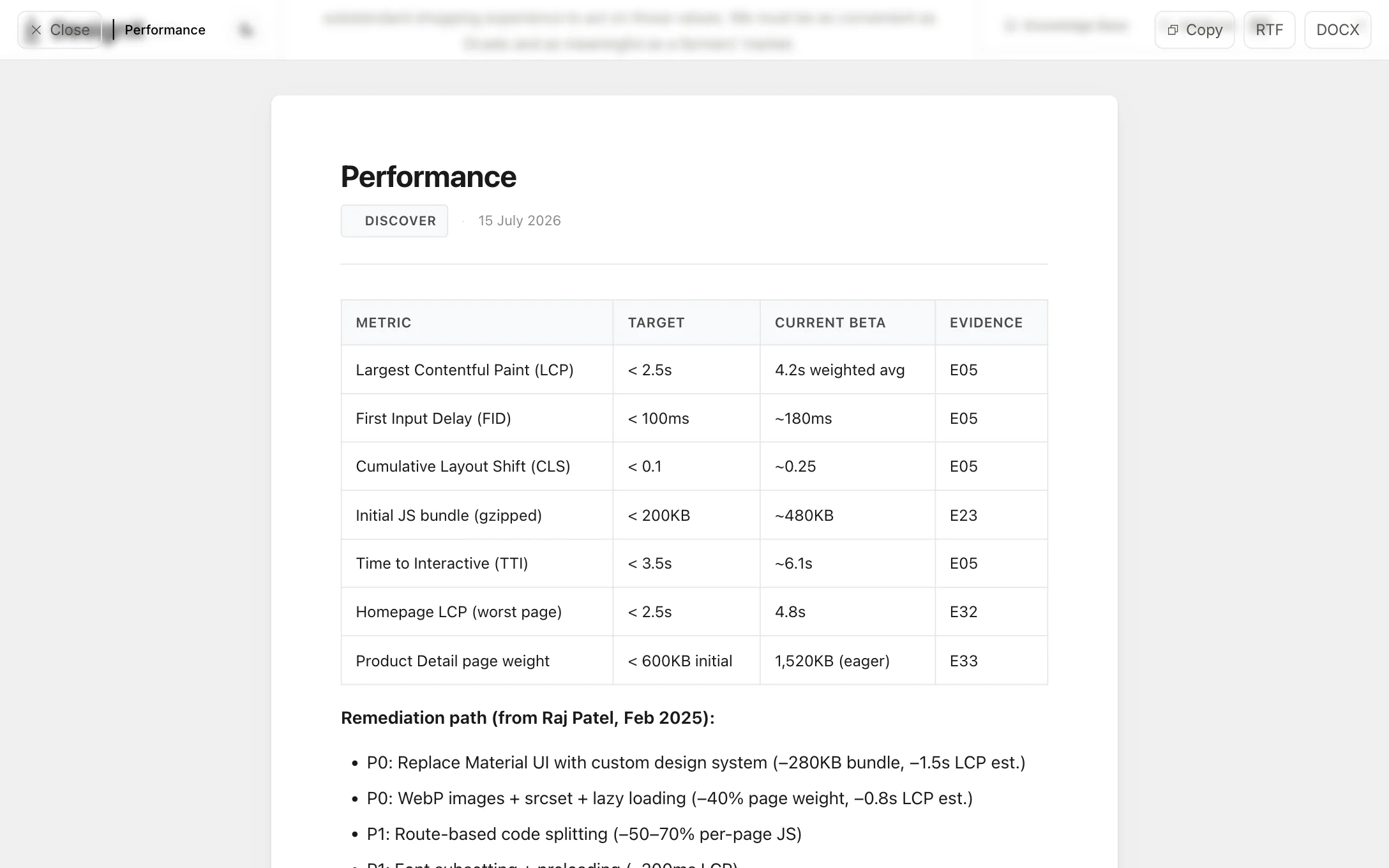
- Stage
- Evidence
- Phase
- 01 Discover
- IDs
- E22, E36
- Stage 2 of 4 · Insight · INS-08
The value is invisible at the decision
The subscription offers genuine economic value, but it is never shown at the moment it matters: checkout, when the delivery fee appears. Confidence HIGH, sourced to E22 and E36.
Artefact · INS-08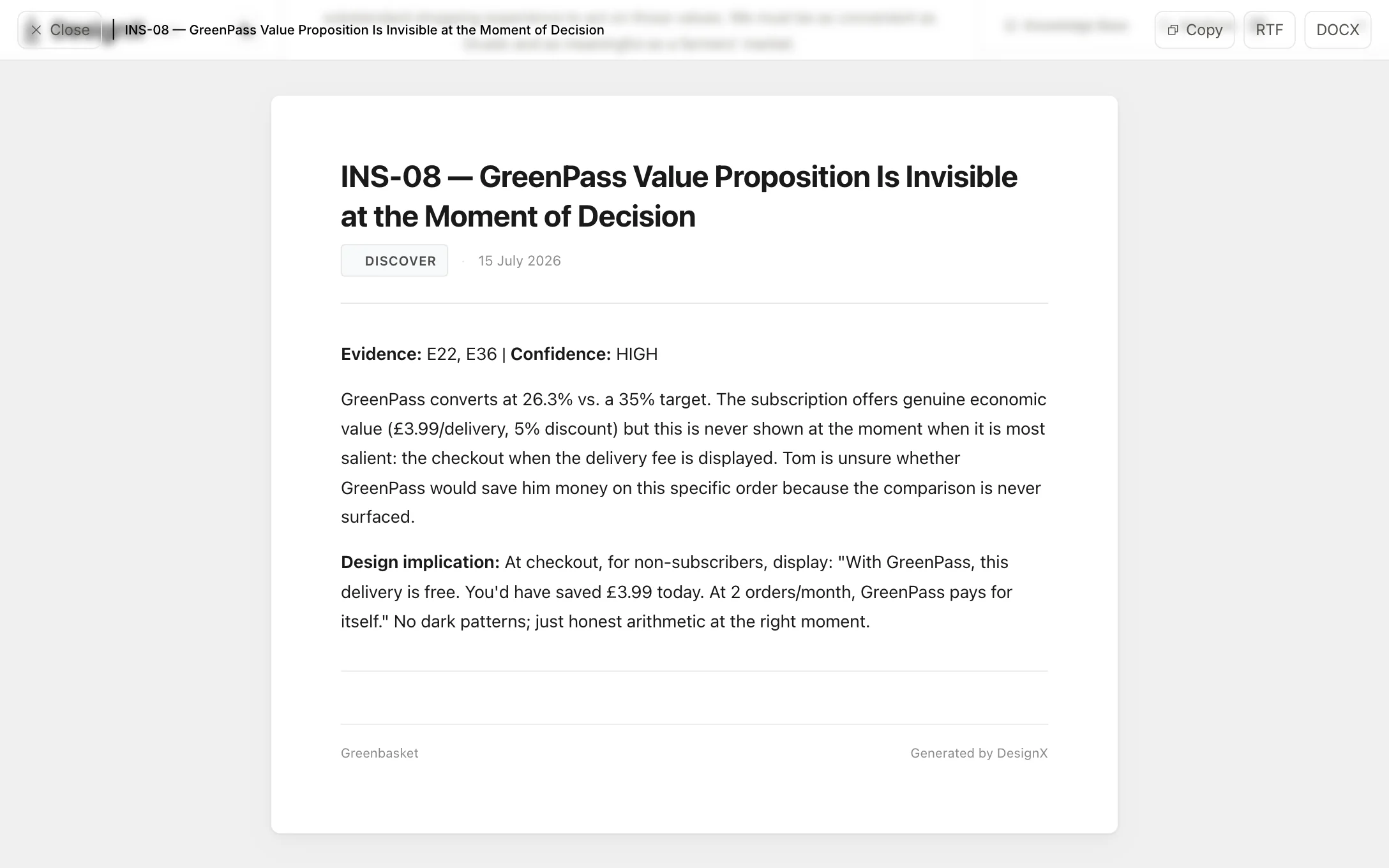
- Stage
- Insight
- Confidence
- HIGH
- Sourced to
- E22, E36
- Stage 3 of 4 · Design implication · D3
No dark patterns; just honest arithmetic
The artefact does not stop at the finding. It writes the rule: at checkout, show non-subscribers what they would have saved on this order and nothing more manipulative than that.
Artefact · D3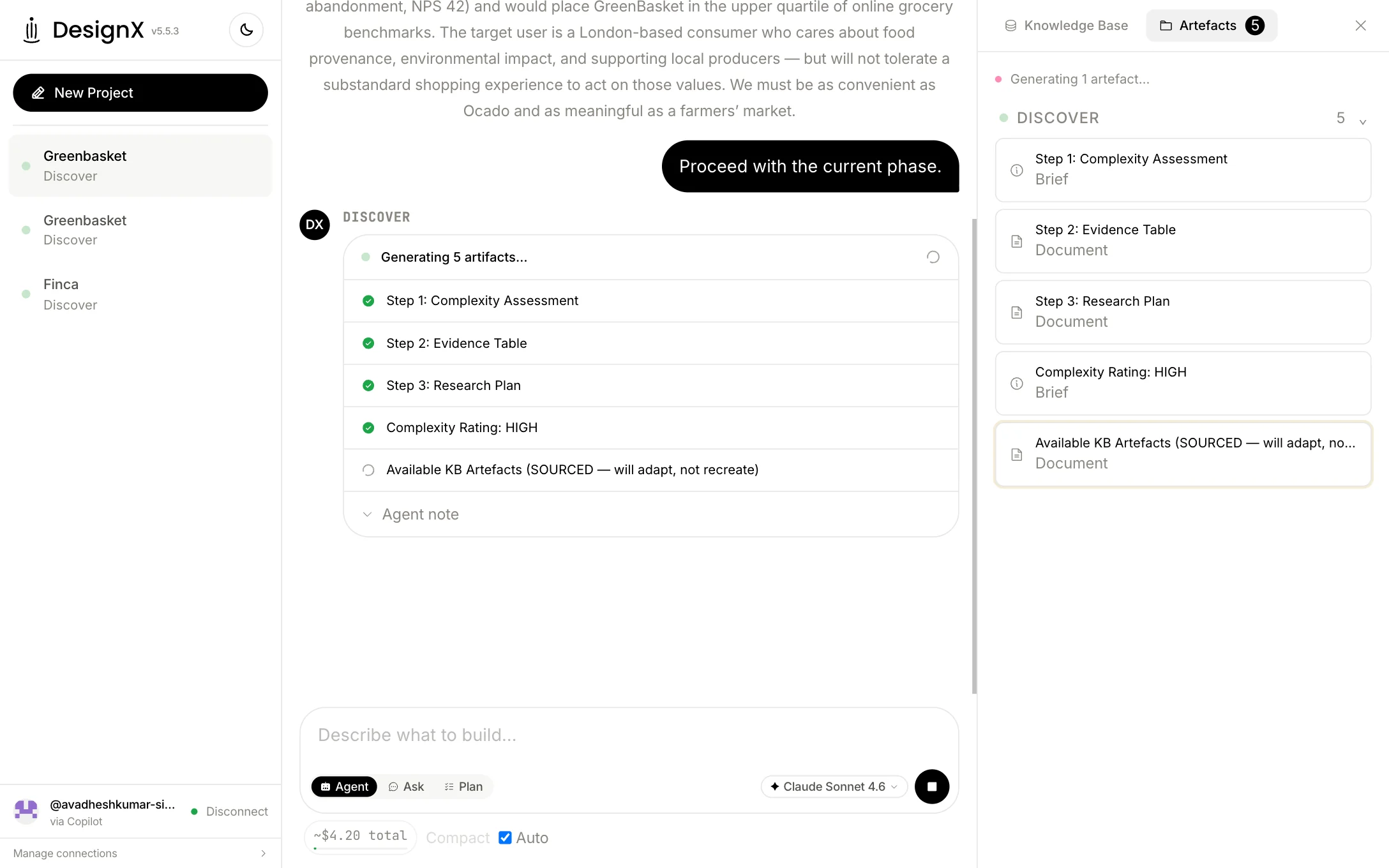
- Stage
- Implication
- Derived from
- INS-08
- Contract
- Sourced, not recreated
- Stage 4 of 4 · The pixel · Built
Arithmetic, on the checkout screen
The order summary states subtotal, delivery and total with nothing hidden, then reports the basket’s Impact Score. The line traces back, unbroken, to a row in a spreadsheet.
Artefact · Built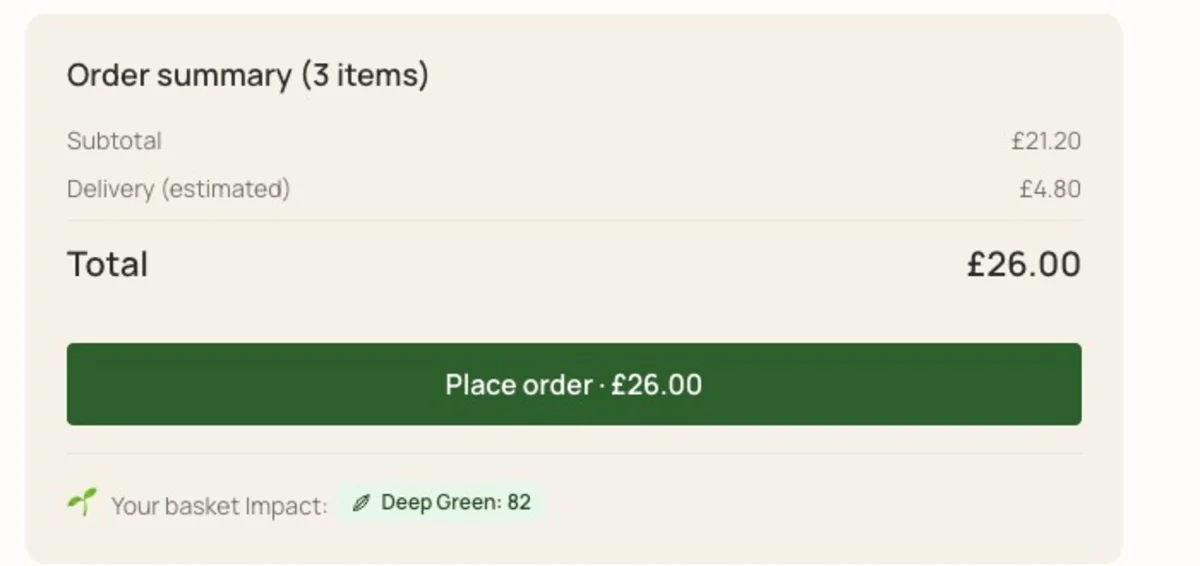
- Stage
- Built
- Traces to
- E22 via INS-08
- Screen
- Checkout summary
Real output from the GreenBasket run, not a reconstruction
07 · Traceability
Every pixel can name its source.
GreenBasket is a fictional London grocery marketplace, set up to test the pipeline. One of its screens, traced backwards to the survey row it came from.
- Stage
- Evidence
- Phase
- 01 Discover
- IDs
- E22, E36
Real output from the GreenBasket run, not a reconstruction
08 · The eval
A tool that grades its own work at five out of five is not an eval, it is marketing.
Generation is easy to fake and hard to trust. So the pipeline scores its own output against a designer-QA rubric across eight dimensions and reports the low scores as loudly as the high ones. The GreenBasket run came back at out of 5 with 16 named gaps, every one resolved to a production spec before delivery.
Scored 5 · Two dimensions
- Content & copy
- Token discipline
Scored 4 · Five dimensions
- Visual hierarchy
- Accessibility
- Responsiveness
- Component structure
- Performance
Scored 3 · One dimension
- Interaction detail
The lowest score is the point
Interaction detail scored 3. That is the number I care about most.
The rubric exists to produce a worklist and a 3 is where the next run starts. Each gap arrives as a named, specified fix: not “improve the interactions”, but the component, the state and the intended behaviour.
09 · The record
The deliverable is not the screen. It is the system that produces screens.
A one-shot tool hands you a picture. DesignX hands you the argument for every pixel in it and the system that will produce the next hundred consistently.
Evidence
Every source in the knowledge base, indexed and addressable by ID.
Insights
Findings that cite evidence IDs and carry an explicit confidence level.
Design system
Tokens, components and states, produced before any screen is drawn.
Production specs
Screens specified against the system, each traceable to the insight beneath it.
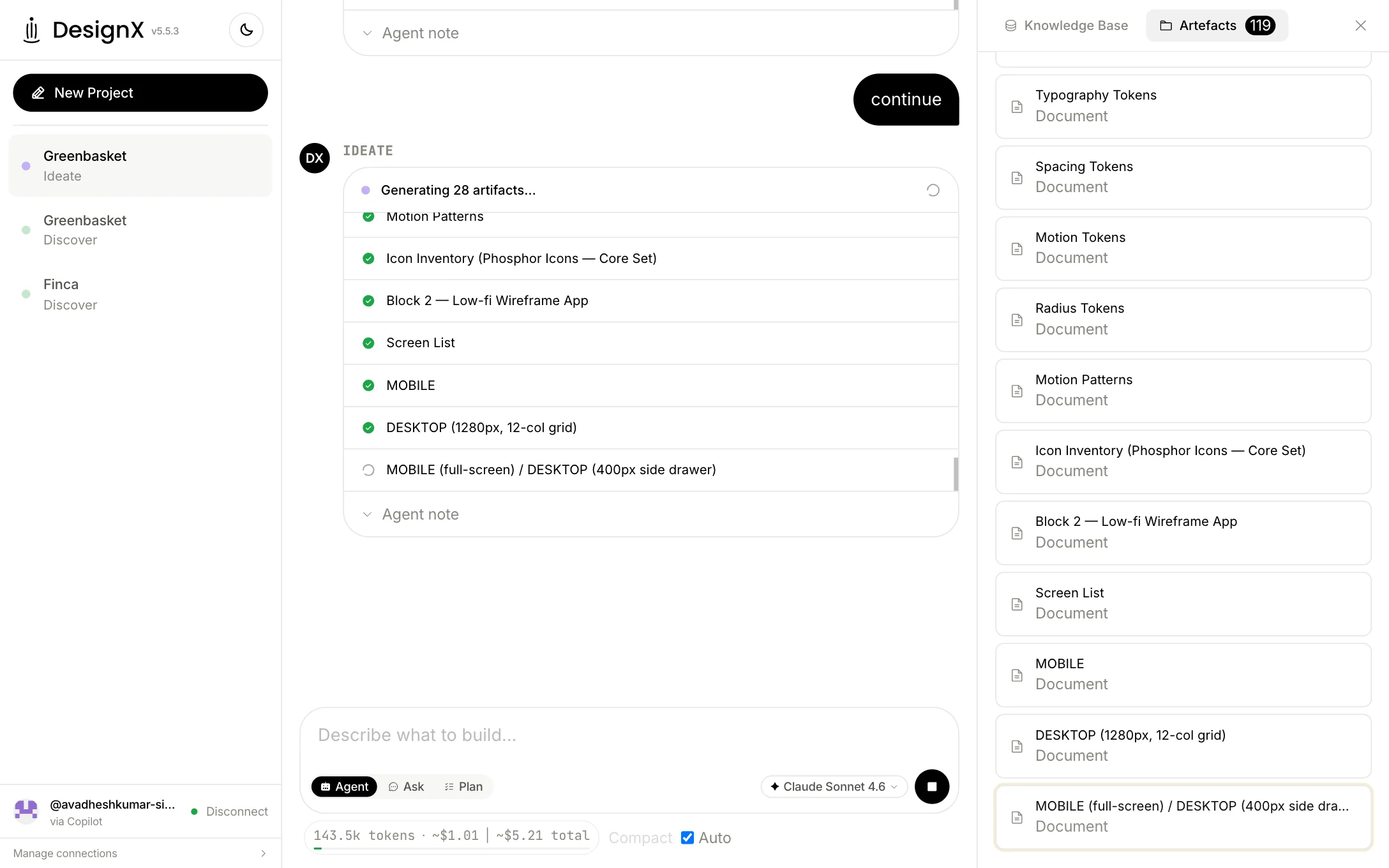
- Phase
- 03 Design
- Gate
- VDG
- Produced
- Before any screen
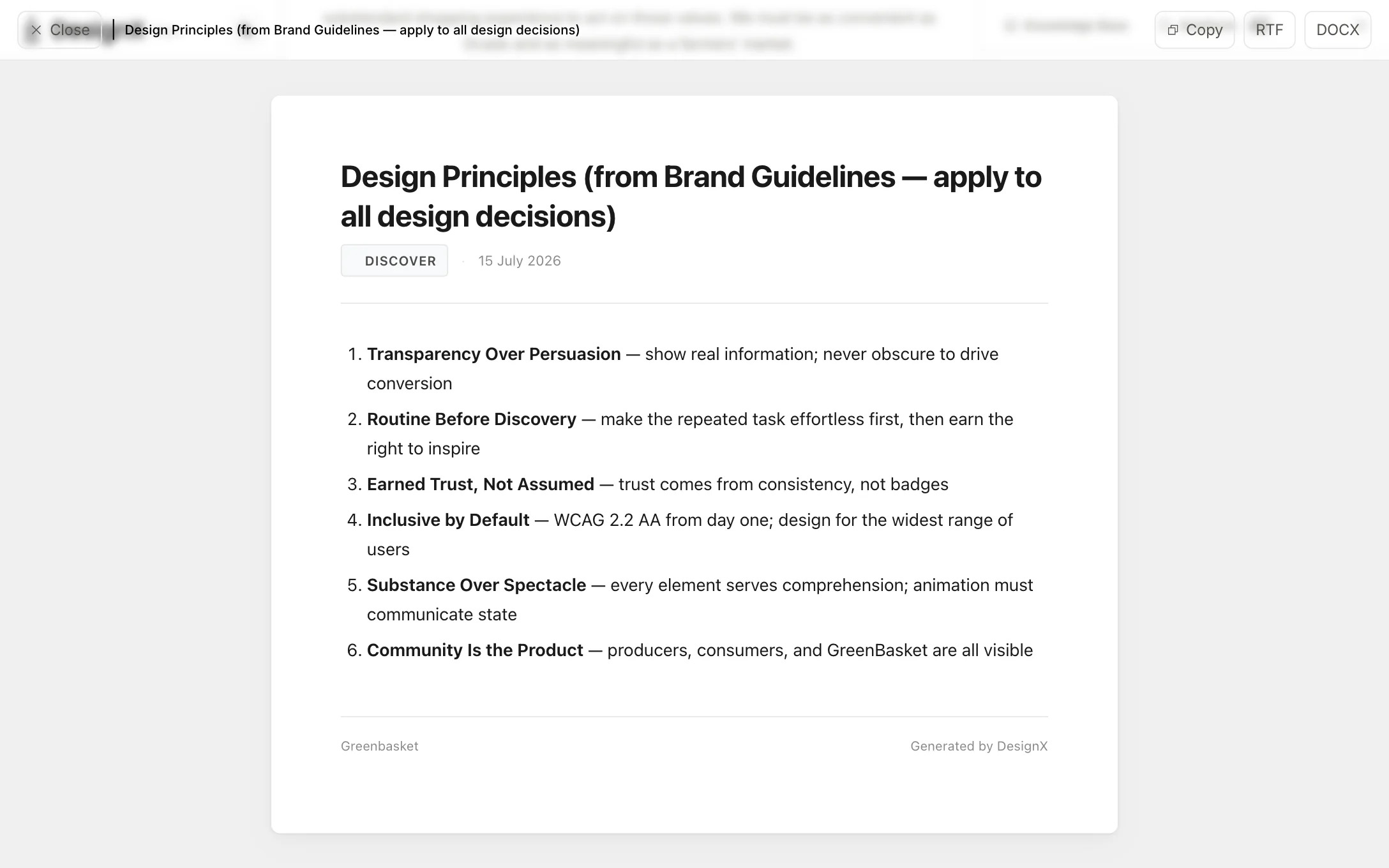
- Phase
- 03 Design
- Derived from
- Research, not a template
- Screens argued against
- All
10 · The output
From brief to a working app.
- Opportunity
- Grocery delivery as convenient as your usual shop and as meaningful as your local market.
- Problem
- Trust and how easily a confusing label or a silent substitution erodes it.
- Answer
- The three decisions that follow are the run’s answers.
- Screens
- Untouched: a working front end built from the generated design system, with real copy and real product logic.
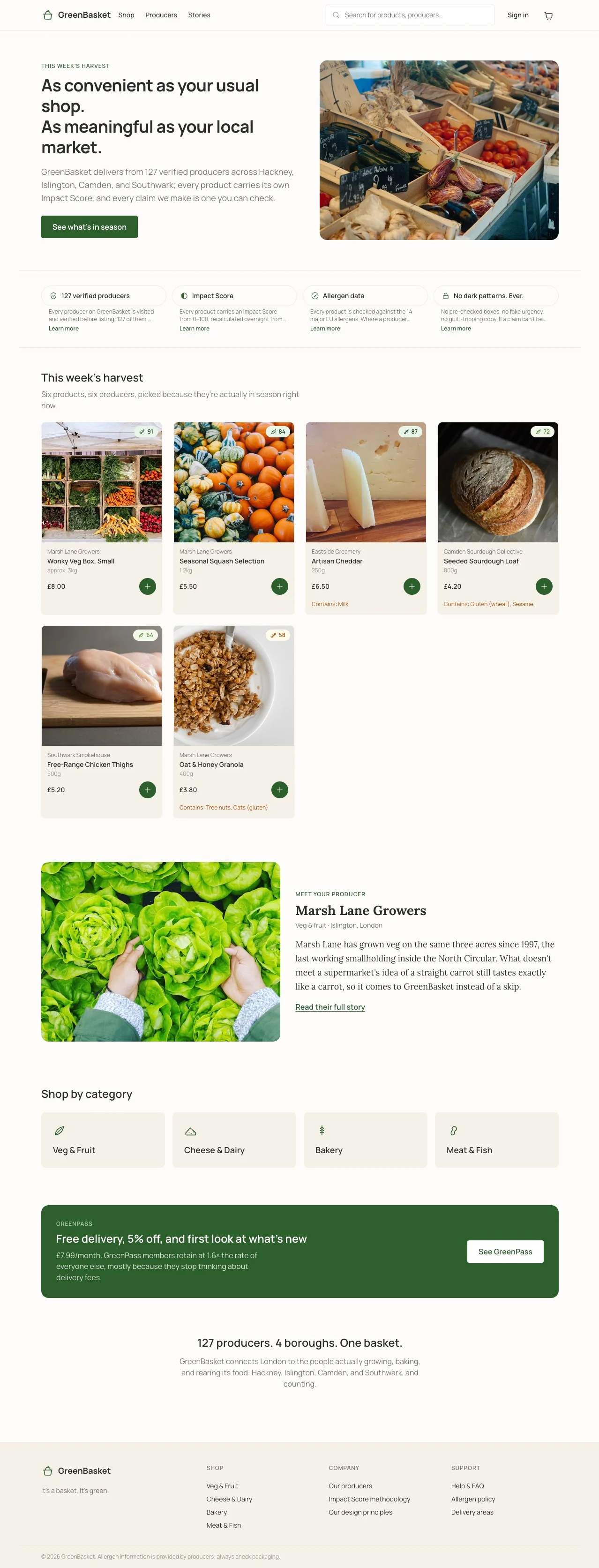
- Phase
- 04 Deliver
- Gate
- D3
- Built from
- The generated design system
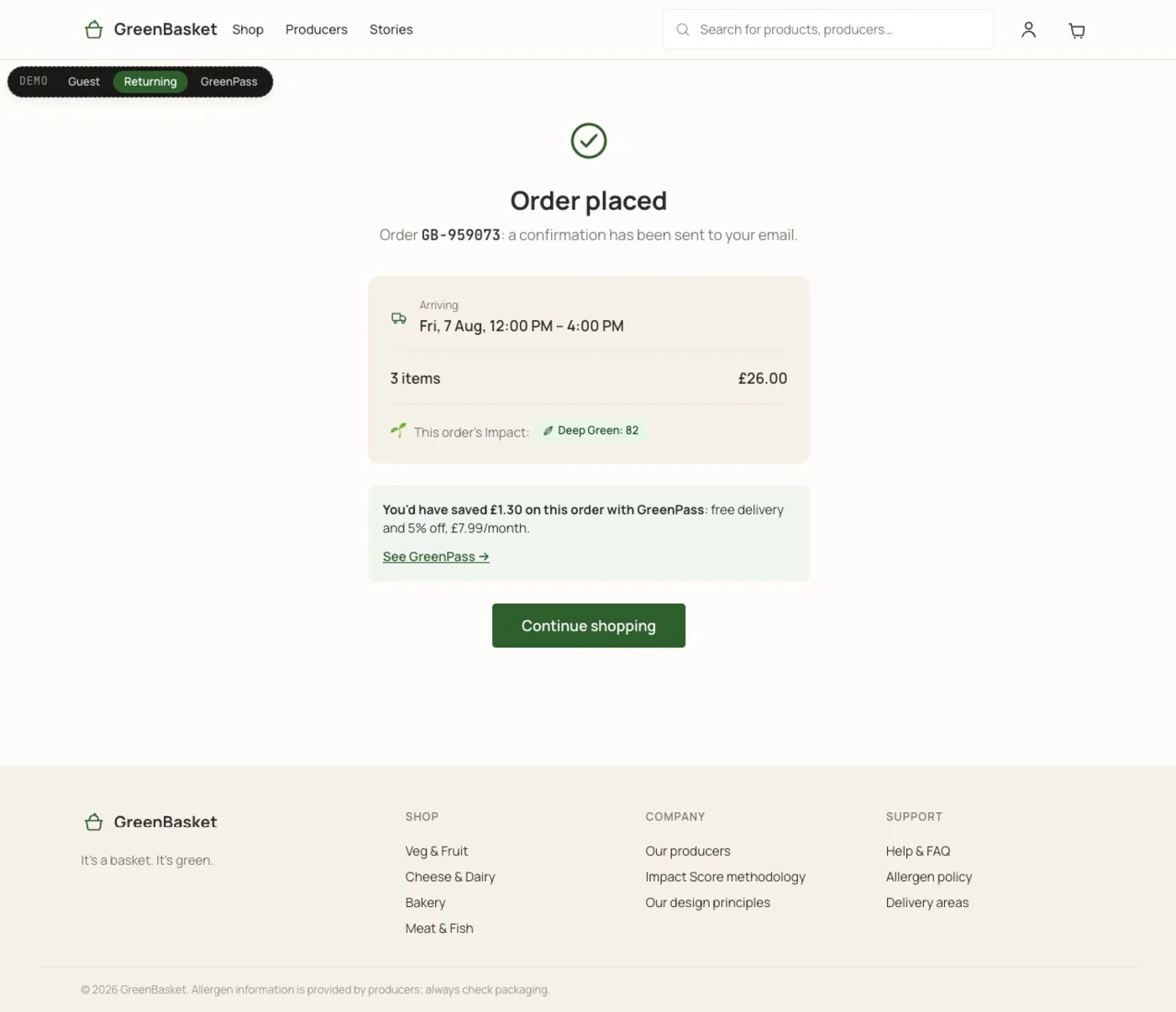
Three decisions worth pointing at
Every claim has a “Learn more”
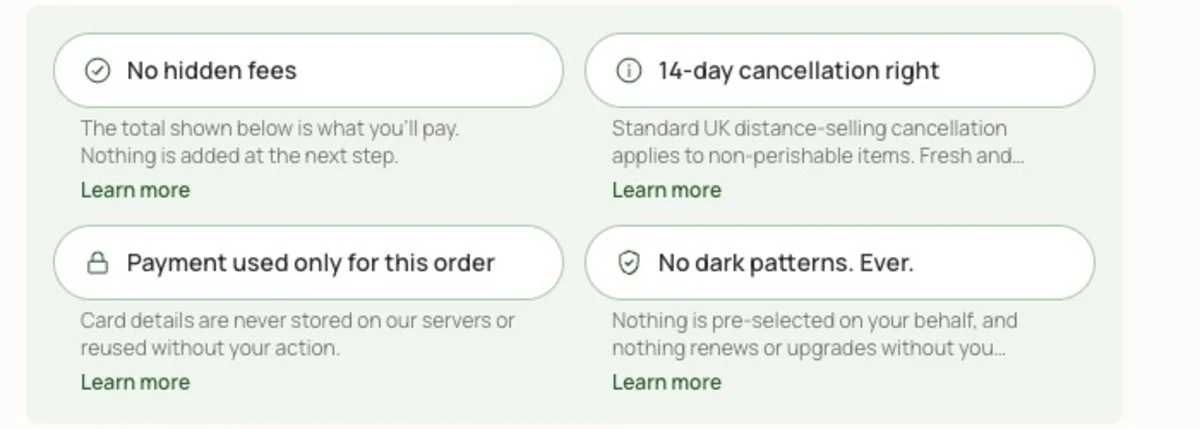
Four trust claims sit above the fold, and not one of them is a bare assertion. Each opens its own methodology. “No dark patterns. Ever.” is an unusual thing for a generated store to promise, and it traces directly to the INS-08 implication.

Substitution is a preference, not a surprise
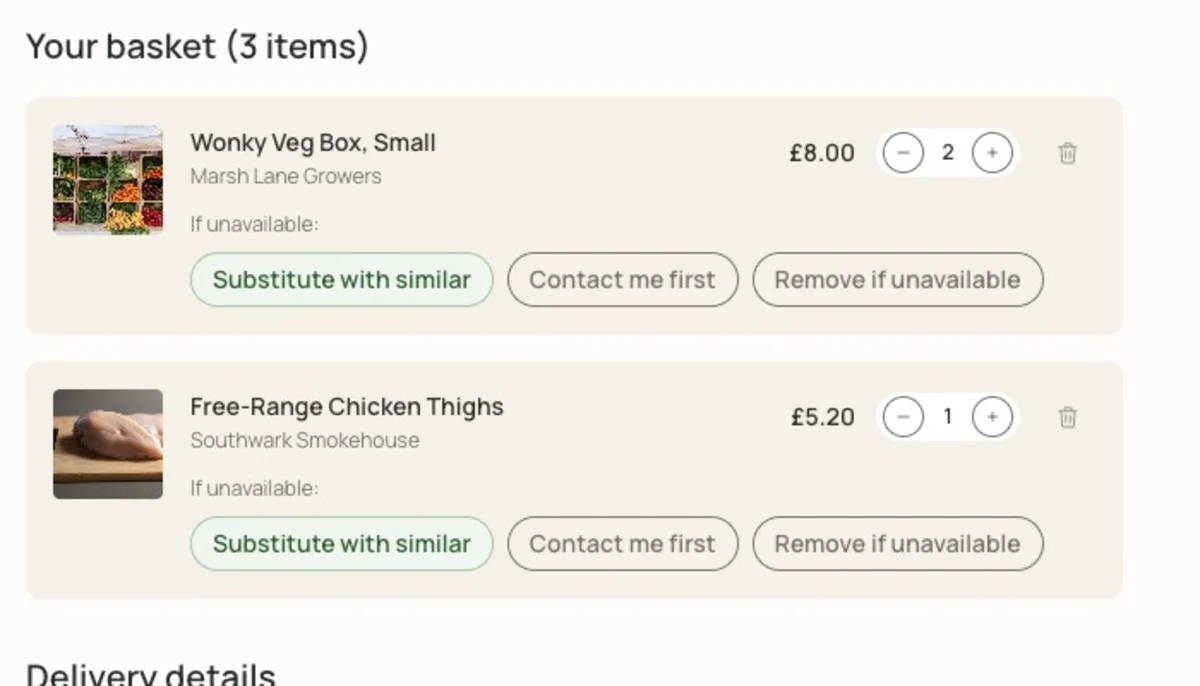
Every basket line carries its own “if unavailable” choice: substitute, contact me first, or remove. Fresh-grocery delivery lives or dies on this interaction, and the pipeline surfaced it per item rather than burying one global setting in an account page.
Allergens on the card, not the detail page
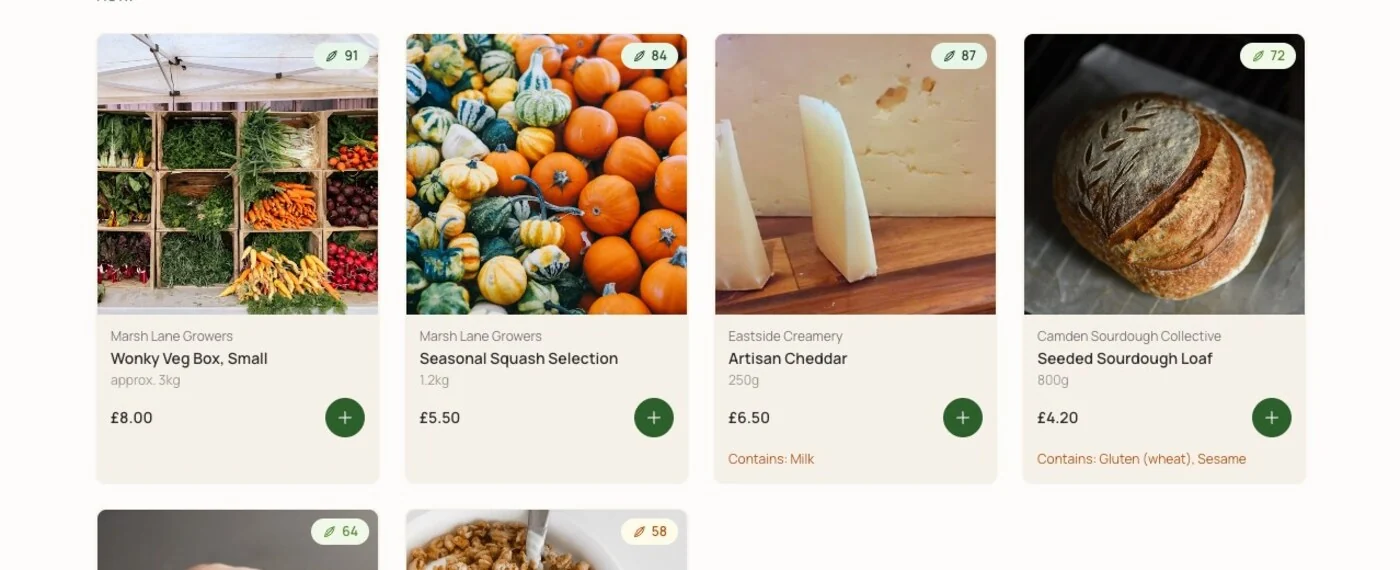
Products are checked against the 14 major EU allergens, and the warning renders on the card itself. The Impact Score badge sits in the same corner on every tile: the kind of consistency that comes from specifying a component before drawing screens.
11 · Proof
npm downloads, May to September 2026
Proof it wasn’t a prototype.
I pushed to publish DesignX on npm early, to test it with a community. The answer was clear: a real opportunity.
71 releases in 22 days
Nothing sent to an outside server
Copilot, Ollama, LM Studio or a team’s own key.
Client work
Open source
No longer maintained on npm.
The lasting idea isn’t the agents. It’s that when design becomes a pipeline, the deliverable stops being a screen.
It becomes the system that produces screens: every decision traced, defended and re-run.