Voting Portal
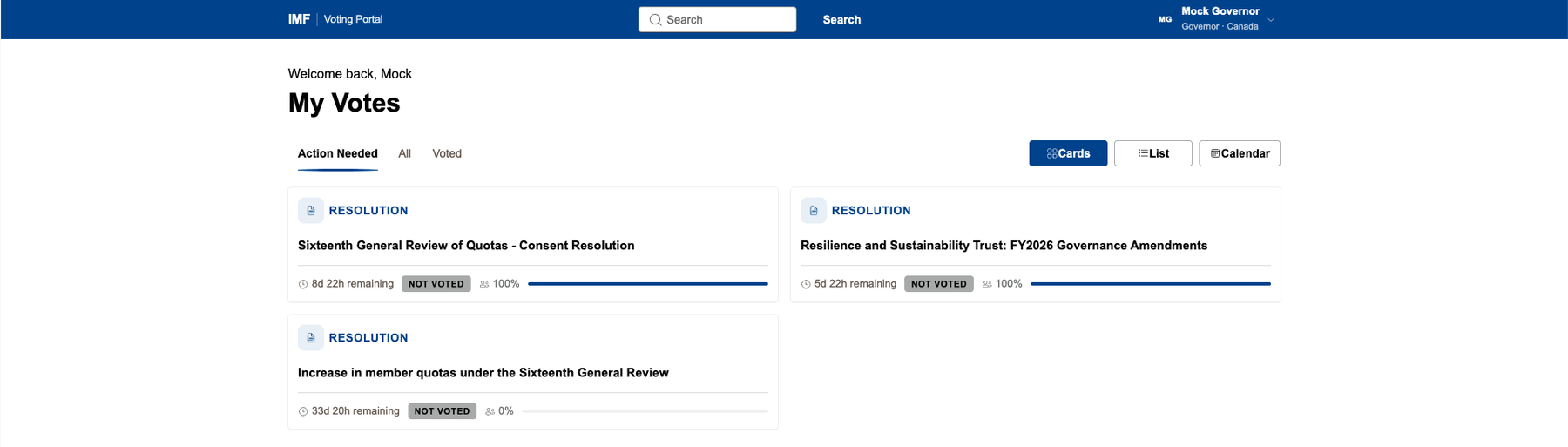
Governors · Alternates · Transmitters
Assigned votes surface as scannable cards. Nothing is buried behind a search.
01 Design orchestration
In a two-week RFP sprint we used an AI-native design workflow to translate dense IMF source material into aligned research artifacts, product specs and coded interface prototypes for three role-specific platforms.
26 source documents
AI-native design orchestrator
Alignment gate
3 working platforms
0
Source documents
0
Week RFP sprint
0
Working platforms
AI-native
Design orchestration
The brief arrived as 26 institutional documents and no room for placeholders.
02 Translation
The challenge was not scale. It was translating institutional rules, voting power, meeting governance, role authority and audit expectations into interfaces that people with real constitutional obligations could trust.
Membership
The RFP was not asking for mockups. It required a defensible chain from institutional rule to product behaviour to working prototype.
Day 1
Brief received
Week 1
Understanding aligned
Week 2
Three platforms running
Day 14
Prototype submitted
03 Operating model
AI compressed the artifact-generation loop. Human design gates protected interpretation, alignment and institutional correctness. The two tracks ran together, and neither one was allowed to overtake the other.
Machine acceleration
Select a stage to see the judgment call
Human design judgment
Extract Align — research.md
research.md was not a write-up. It was the alignment check: did the team read the domain the same way, before a single specification was generated.
research.md and prototype documentation.md were not documentation after the fact. They were alignment artifacts that checked whether the team understood the domain before generating specs and interfaces.
The design artifact was not a static Figma file. The design artifact became a living coded interface.
My focus sat at the gates: turning AI-generated artifacts into aligned product decisions before interface generation, not after it.
04 System structure
Rather than one overloaded platform, the experience was split into three focused environments. Each is shaped by what its users are accountable for, and all three sit on the same rule bedrock.
Governors · Alternates · Transmitters
Assigned votes surface as scannable cards. Nothing is buried behind a search.
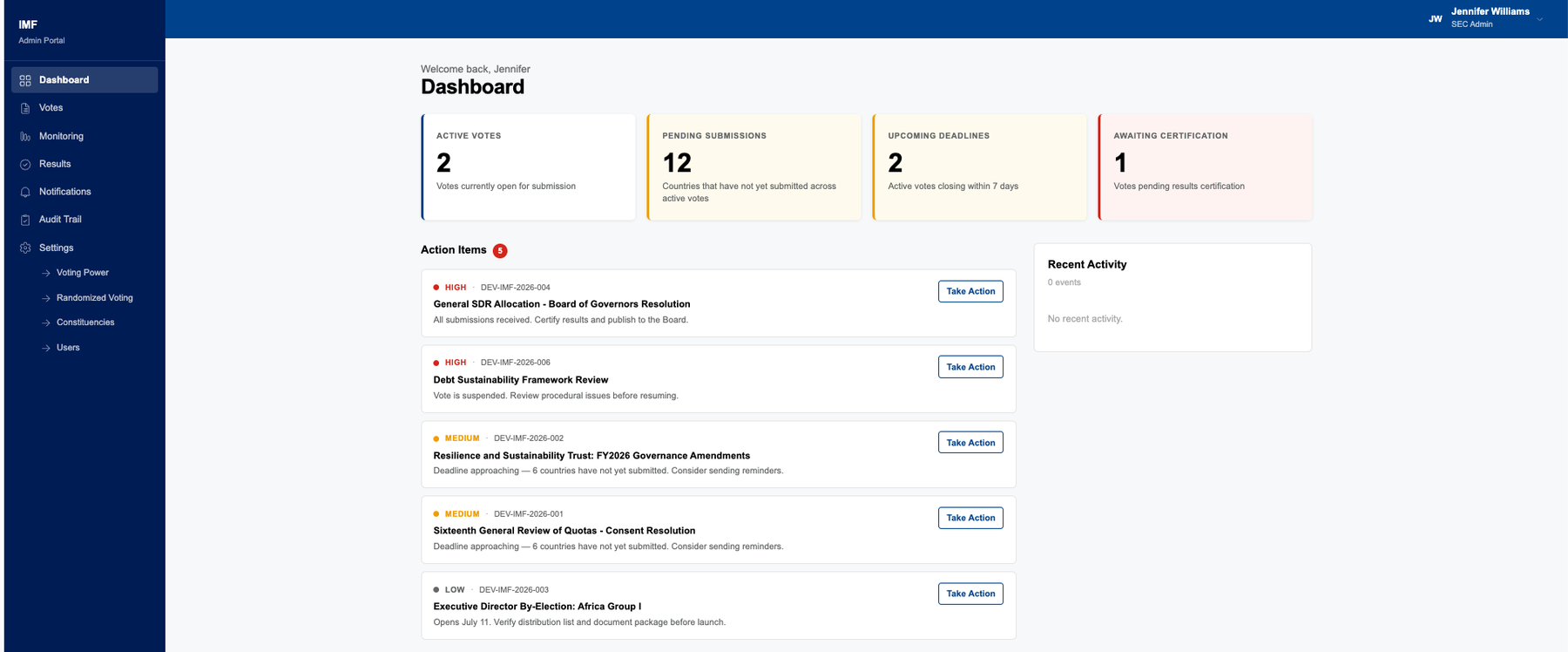
Secretariat administrators · Staff · OED officers
Counts and the actions that clear them live in one view, so nobody switches screens to work.
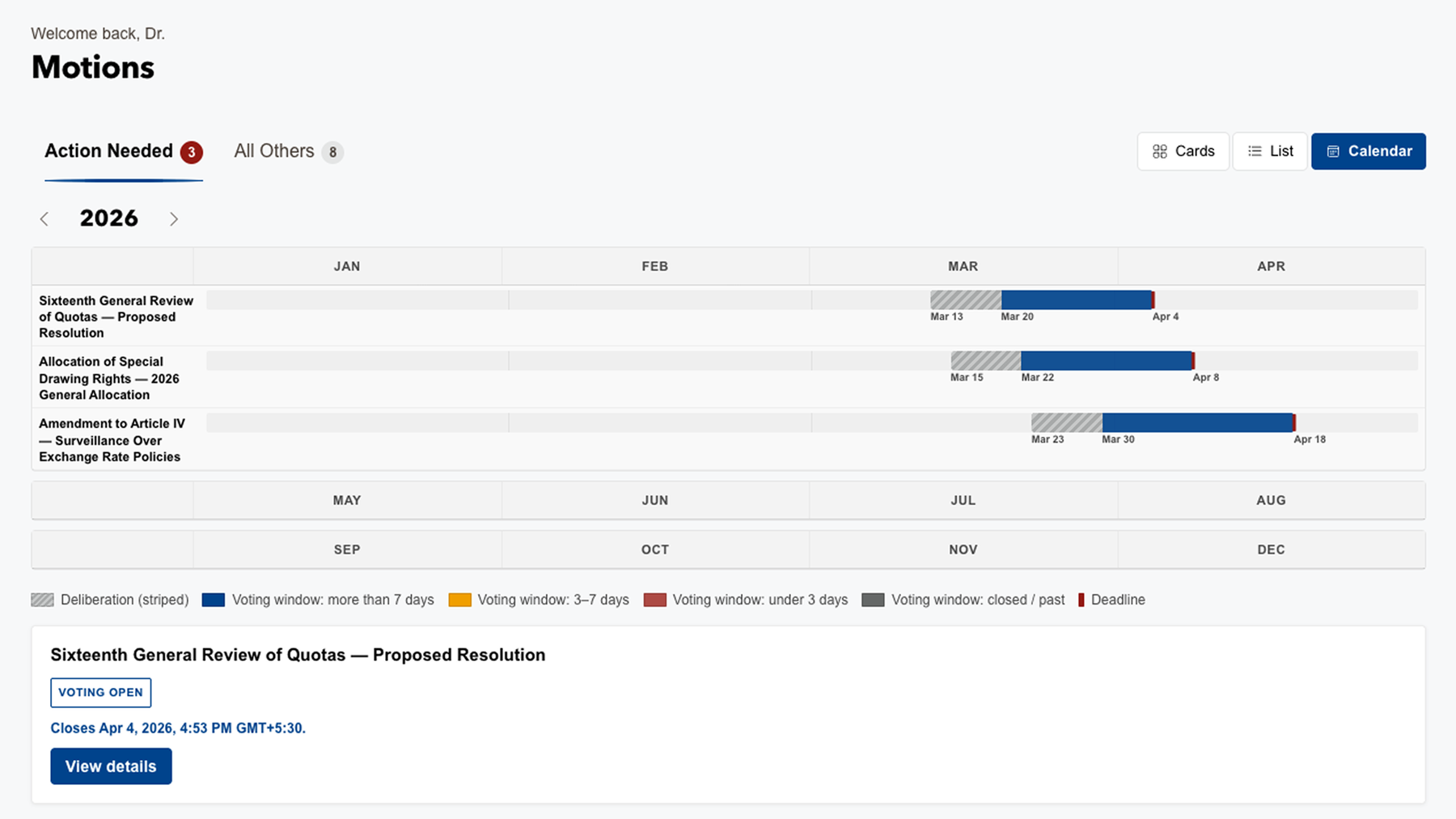
Board-calendar and meeting lifecycle participants
Status pills carry each consultation's state directly on the calendar.
Shared rule bedrock
05 Design system
The visual system had to preserve IMF identity, restraint, accessibility and clarity while stretching a deliberately limited palette into a production interface across three products.
01Identity
Fund blue, approved typography, protected logo. The institution’s mark was a constraint, not a starting palette.
02Derived palette
Approved shades and tones extended into hierarchy, surfaces, states and alerts without inventing a new brand.
03Accessibility
WCAG AA, keyboard operation, visible focus, readable errors. Non-negotiable across all three environments.
04Interaction tone
Low-noise components, explicit states, restrained motion, audit-friendly flows. Nothing that implies a decision the system has not made.
Derived from the approved mark
900
#001E60
Identity anchor
700
#004C97
Primary action
500
#2F6FAE
Secondary marks
100
#DBE7F5
Surfaces
50
#F0F5FB
Tinted panels
The approved IMF palette alone could not carry a multi-portal interface. We agreed derived shades and tones so the prototype could express hierarchy, states, warnings and accessible contrast without breaking institutional identity.
Design rules were treated as delivery infrastructure, not a finishing layer. They were written before the first screen and enforced in code, which is why three products built in two weeks still read as one system.
A system can look correct and still leave a governor unsure whether a motion actually passed.
06 Governance states
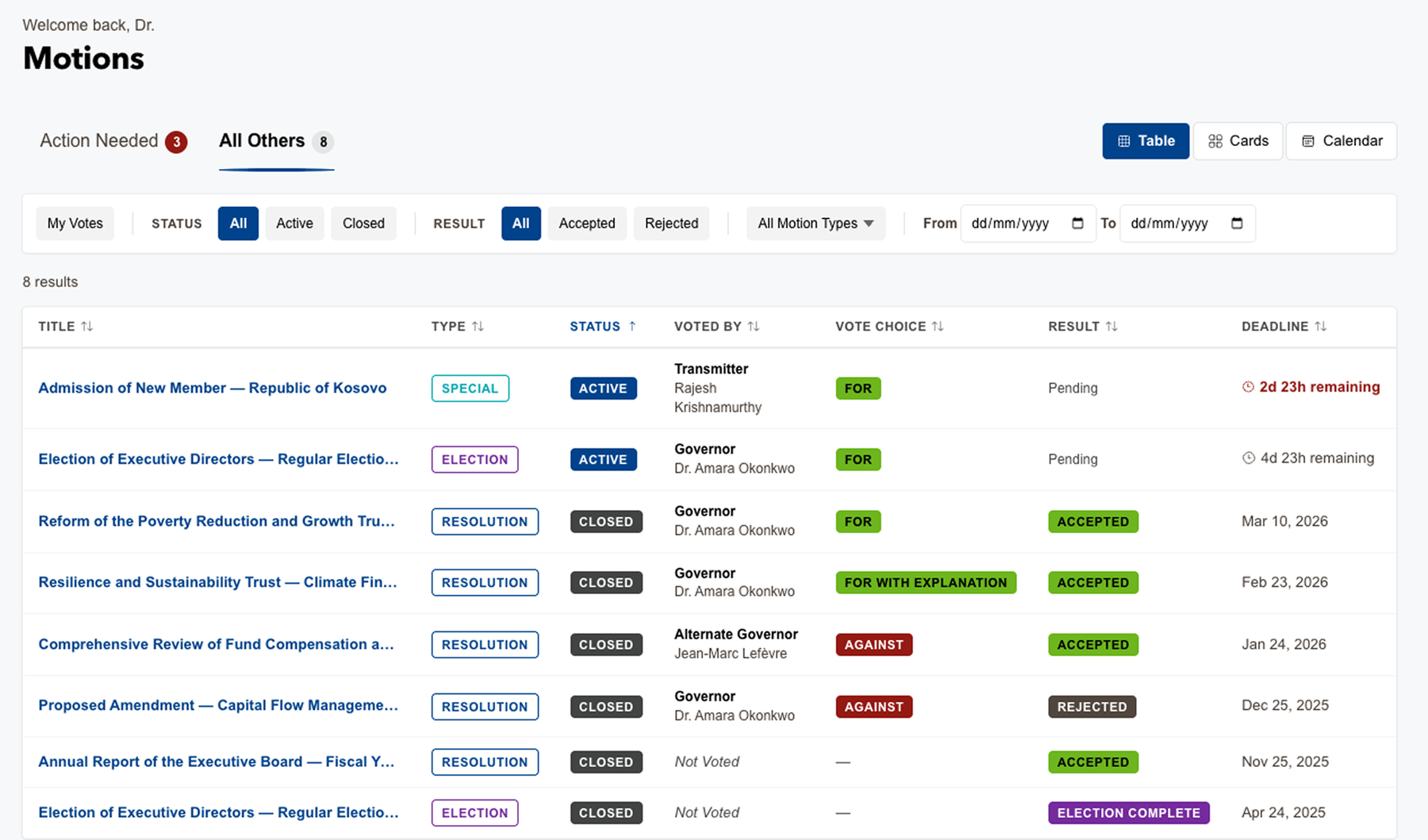
The hardest design work was not drawing screens. It was turning institutional rules into visible states, available actions and legitimacy cues that a governor could act on without asking anyone what the interface meant.
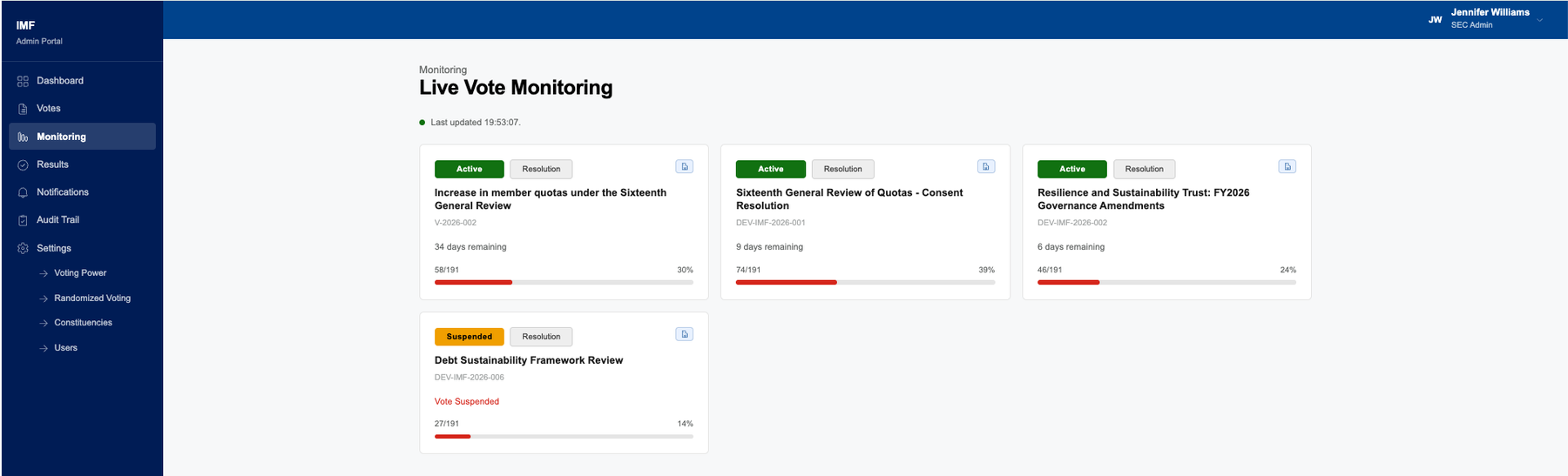
What needs my vote?
ActiveSuspended
An active vote can be halted on procedural grounds. Suspension is a first-class state with its own view, not an error, because inside an institution a paused vote is a legitimate outcome that people still have to reason about.
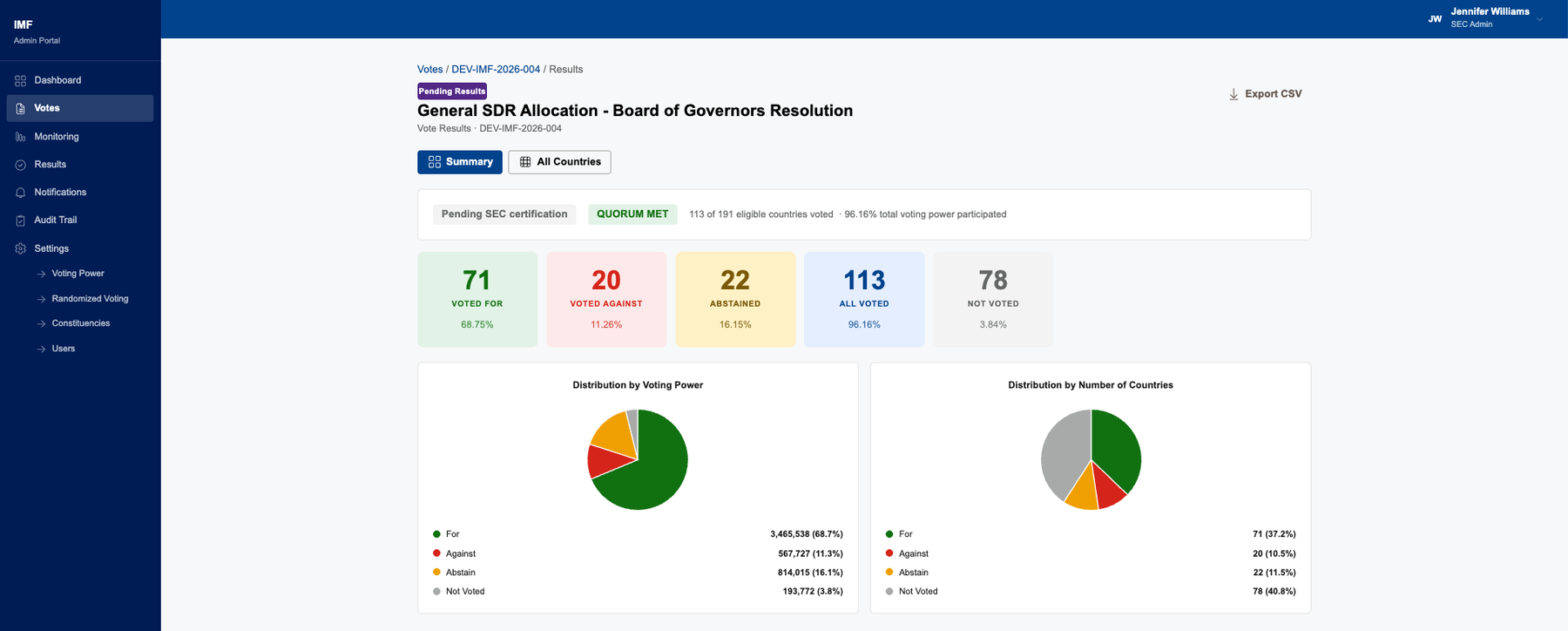
Did the motion legitimately pass?
68.7% for
Voting power, SDR weighted
Same vote,
two readings
37.2% for
Country count, one nation one voice
07 Design review loop
Across the two weeks I refined interface decisions directly in frontend code and pushed reviewable updates to the Azure monorepo every one to two hours.
Instead of waiting for a Figma handoff cycle, the team reviewed working interface updates directly in the running build.
This mattered most for BCMS, where scheduling states and calendar behaviour needed repeated validation against real dates rather than against a rendering of one.
The design focus stayed on refining interface decisions in frontend code and pushing reviewable updates, which meant every review argued with something that actually ran.
08 Reflection
The prototype proved that AI can accelerate decomposition, specification, prototyping and testing. It also proved that institutional product design still depends on someone deciding what is correct.
Judgment gates operated here
AI changed the speed of production, not the need for design judgment.
It shifted the designer’s role toward orchestration, constraint-setting and rapid validation. In a governance system, that shift is not a convenience. It is the only reason velocity was survivable.
IMF Governance Platform · EPAM Systems · Lead UX Designer