Piplsay · Sep 2021 – Feb 2023
A natural language based quant research platform, for amateurs and pros alike.
Ask in one plain sentence. Piplsay fields it to a live panel and answers in hours, not weeks.
Lead product designer · 3 designers · Beta, March 2022
Step 1 of 3 · Tell us what you’d like to know
I want to hear from General Population about insights on MacBook Pro so that I can understand how people feel about it, how satisfied they are and whether they’d buy it
Resolved into
- General Population · 168,200 reachable
- MacBook Pro · product
- 15,000 respondents
- Affect, Like/Dislike, Satisfaction · constructs
- liked or loved it
- 84%
- satisfaction
- 4.3 / 5
- countries answered
- 14
- Client
- Piplsay, by Sago
- Product
- Self-serve quantitative research, NLP-driven
- The brief
- One interface a senior analyst and a first-time brand manager could both use
- My role
- Lead Product Designer
- Team
- 3 designers, plus product, research and engineering
- Period
- Sep 2021 – Feb 2023 · beta March 2022
- Surfaces
- Buyer side and respondent side
Study card
Key results from beta
42 days →
4 hours
Median time to a first usable insight
58% →
81%
First-time buyers completing a brief unaided
71% →
88%
Respondent completion on expressive controls
0% →
34%
Studies launched from a recipe
Four terms. Quant research: asking many people the same structured questions, so the answers can be counted. Sample: the people who answer. Confidence and margin: how sure a result is and how far off it could be. Construct: a validated set of questions that measures one thing.
02 / Context
Everyone had picked a side
Seven platforms, ten criteria, six weeks of benchmarking (Oct to Nov 2021). Every tool traded ease for depth, and the corner where both meet was empty. That corner was the brief.
Verdicts, as recorded on the board
Scored on: ease of use, interface, templates, customisation, integrations, advanced features, pricing, mobile, reporting and who each was built for. Entry pricing ran $19 to $99.
03 / Readers
Two people who could not share a tool
| Alex RiveraSenior market research analyst | Jordan LeeBrand manager, 29, tech proficiency moderate | |
|---|---|---|
| In their words | “How can I maximise the quality of insights with minimal time investment?” | “I want to make data-driven decisions without getting bogged down by complexity.” |
| Cadence | Runs studies weekly | A study a quarter, at most |
| Fluency | Quotas, scales, significance | Has never set a quota |
| Judged on | Defensibility | The decision, not the method |
| What they lose | A tool that makes her work look amateur to the people who commission it. | Spending the budget and finding out afterwards the numbers meant nothing. |
Four conflicts, each answered below
None could be a setting: a setting asks the reader to know the answer already.
Writing the brief
Let me specify the sample frame, the quotas and the scale.
I do not know what a quota is, and I do not want to learn today.
→ R1
Reading the result
Show me the cross-tabs and let me cut them myself.
Tell me what this means and what I should do next.
→ R2
Sizing the sample
95% confidence and tell me the margin of error.
How many people is enough? What does enough cost?
→ R3
Choosing what to measure
Give me validated constructs I can defend in a readout.
I want to ask whether people like it. In those words.
→ R4
04 / How I ran it
Seven months, two surfaces, two gates
A two-sided platform fails in the middle. I split the team along that seam and held the middle myself.
Avadhesh
Lead · both surfaces
Scope, touchpoints, benchmarking, prioritising ideas, user flows, IA, high fidelity, client-side testing. Gates: Present ideas, Present prototypes.
Associate designer
Buyer journey
Personas, visual language, hypothesis, brainstorming, storyboards, task flows, wireframes, clickable mock-ups, client-side testing. Milestone: Document research.
Associate designer
Respondent journey
Empathy maps, user stories, How might we, Crazy 8s, storyboards, user flows, wireframes, clickable mock-ups, respondent-side testing.
- Split by surface, not screen
- One associate designer per journey. I held scope, benchmarking, flows and IA across both.
- Two gates
- Present Ideas in December, Present Prototypes in February. Written decisions between.
- A parity board
- Every feature’s real status with a note. It ended most “is it done” arguments.
- Converging in public
- Three tiers, one recommendation, then a direct input, with the reasoning kept beside each.
45 features, mid-flight
A snapshot from partway through, not a verdict: real status, with a plain note.
MVP complete · partially built · designed, build pending · queued
Site and access
- Marketing site: Partially built
- Sign up and login: Partially built
- Walkthrough: MVP complete
- Onboarding: Queued
Dashboard
- Navigation: MVP complete
- Search existing insights: Partially built
- Insights by status: MVP complete
- Notifications: Queued
- Piplsay insights feed: Partially built
Account
- Update password: MVP complete
- Notification preferences: Queued
- Payment details and package: Queued
- Close account: Queued
- User details: MVP complete
Creating an insight
- Trending topics: MVP complete
- New entity: MVP complete
- Target audience from language: MVP complete
- User-specified target group: MVP complete
- Feasibility: MVP complete
- Capturing the objective: MVP complete
- Classifying an entity: MVP complete
- Manual entity classification: Design complete, build pending
- Suggesting constructs: MVP complete
- Searching constructs: Partially built
- Applying constructs: MVP complete
- Custom question types: Design complete, build pending
- Pretext before a question: Queued
Preview
- Question preview: Queued
Launching
- Review: MVP complete
- Launch: MVP complete
- In-progress page: Partially built
- Pause: MVP complete
Viewing
- Significant data points: MVP complete
- Data visualisation: MVP complete
- Clone a study: Partially built
- Rename after generation: Queued
- Cover image: Queued
- Share by public link: Partially built
- Download raw data: Partially built
- Delete: Partially built
- Refresh and update data: Design complete, build pending
- Version history: Design complete, build pending
Respondent
- Question strategy: MVP complete
- Scale, custom and image answers: Design complete, build pending
- Expressive answer mechanics: Design complete, build pending
05 / Six design responses
Each answers a conflict, or the failure the last one caused
R1Answers: writing the brief
A brief in one sentence
- Problem
- Competitors open on a blank survey. Jordan has a decision in mind, not a survey.
- Response
- Ask for the decision: who, what and why. The system parses it as typed and reports what it read.
Alex · precise
I want to hear from US males 16–24 about brand popularity and affect so that I can defend the readout.
● US males 16–24 · Audience ● Brand popularity · Construct ● Affect · Construct
Jordan · vague and still a sentence
I want to hear from people like our customers about whether they like Italian Cuisine so that I can choose one for the launch.
● people like our customers · Audience, broad ● Italian Cuisine · Product class, Food, Concept ? the launch · unresolved
R2Answers: reading the result
From a sentence to a live report
- Problem
- Jordan wants to be told what it means. Alex wants to see and cut the instrument.
- Response
- Three screens to set up, then a report that fills in as the panel answers. Every question and its exact scale stays one click open.
01 / 11 · Step 1 · who and what
Say who, then name the topic
Plain words, not a query builder. Suggestions filter as you type, and the audience resolves to 168,200 reachable people.
R3Answers: sizing the sample
Statistics you can shop for
- Problem
- Alex asks for confidence and margin. Jordan asks how many is enough and what enough costs. The same question.
- Response
- Name the sizes and let each name carry its statistics, turnaround and price. Or type a custom number, against a pool of 1M+.
Quick Poll
n = 377
±5% at 95%30 mins · 500 credits
Scientific Study
n = 664
±3.8% at 99%2 hours · 1,000 credits
Mega insight
n = 3,500
±1.5% at 99%6 hours · 4,000 credits
Uses: Quick Poll for A/B tests, concepting and sense checks; Scientific Study for brand tracking, likeability and topical attitudes; Mega insight for in-depth analytics on mass opinion.
Step 3 of 3
Launch your insight
Number of respondents
Minimum 2,000 · Maximum 500,000
Cost
Current balance 10,000
Subtotal 1,500
Total 1,500($900)
LaunchPriced by the choice · 520 credits
Every targeting choice is priced as it is made, not at checkout.
R4Answers: choosing what to measure
Teaching method inside the flow
- Problem
- A novice can field a question no statistician would accept, then take it to the board. Blocking makes the product useless; waving through makes it worthless.
- Response
- Read the intent of a custom question and offer the validated construct: yes, no or why. Nobody is stopped.
“It looks like you are trying to find a users attitude to “climate change” would you like to use the “attitude to thing” insight?”
- Because you mentioned “which”Choice
- Because you mentioned “when, how”Product usage
- Because you mentioned frequencyProduct usage
Every suggestion quotes the buyer’s own words back: a reason to check, not a ranking to trust. Built in the flow, never a modal.
R5Answers: the failure R1 created
Being wrong well
- Problem
- The sentence only works if the machine can read it. “Mona Lisa” defeated it completely.
- Response
- The chip always says what it heard, a failure carries its own way out, and trending topics arrive pre-resolved.
Phrase typed → reading → one of five
One type
Samsung: Organisation. Checkable on hover.
Several types
Italian Cuisine: Product class, Food, Concept. A gear corrects it.
Decomposed
“the governments new covid vaccination strategy”: Organisation, Event, Policy.
No match
“Our indexing engine wasn’t able to categorize ‘Mona Lisa’ please check.” The chip turns amber.
By hand
Nine plain categories plus None of these, or classify part of your own phrase. One click.
Three grades of being told no
One error state for everything teaches people to dismiss it. Only two of these stop you.
InvalidStops you
Cannot be accepted as it stands.
“All individual input values need to sum up to 100%”
Region split 29 / 19 / 20 / 22, which adds to 90.
BlockedStops you
Valid, but below a floor the business set.
“500 is the minimum credit required to run an insight study”
400 credits entered.
AdvisoryLets you through
Valid, allowed and probably a mistake.
“We suggest 500 respondents for this study to capture meaningful insights”
490 entered. Launch still allowed.
R6Answers: the other half
Respondents who finish honestly
- Problem
- A stranger on a phone, recruited by a third-party panel, in a mobile browser on someone else’s domain, with no reason to finish. Bored and dishonest answers look the same.
- Response
- Four expressive mechanics instead of radio buttons, each tied to its construct and labelled. Owned by an associate designer.
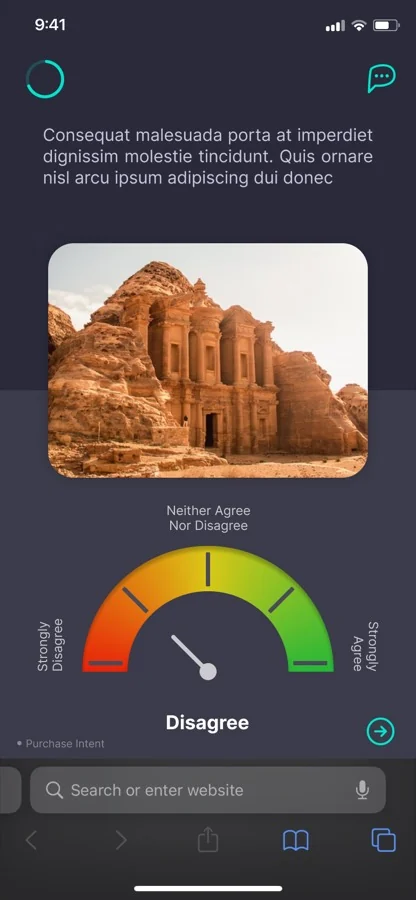
Gauge
Agreement
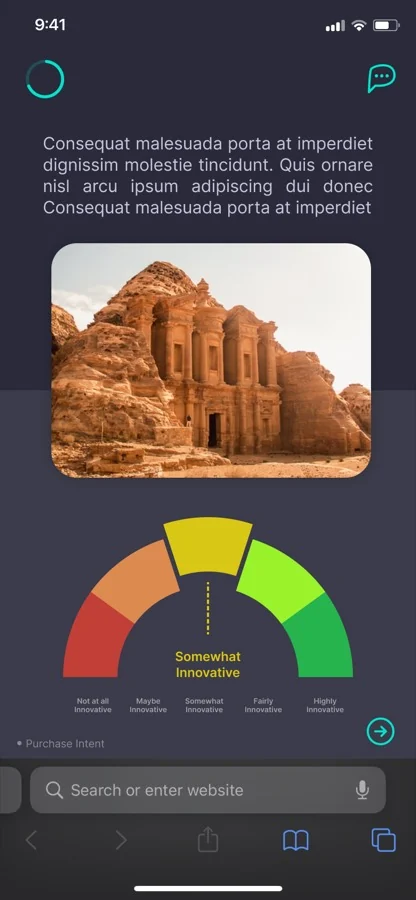
Segmented arc
Five-point scale
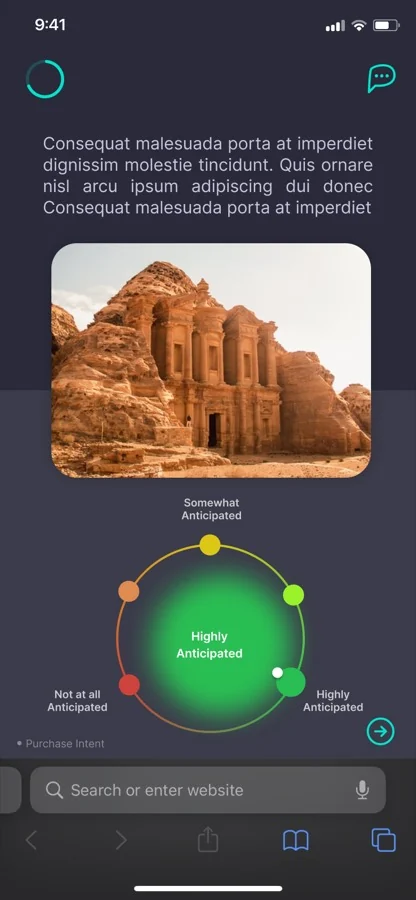
Radial fill
Intensity
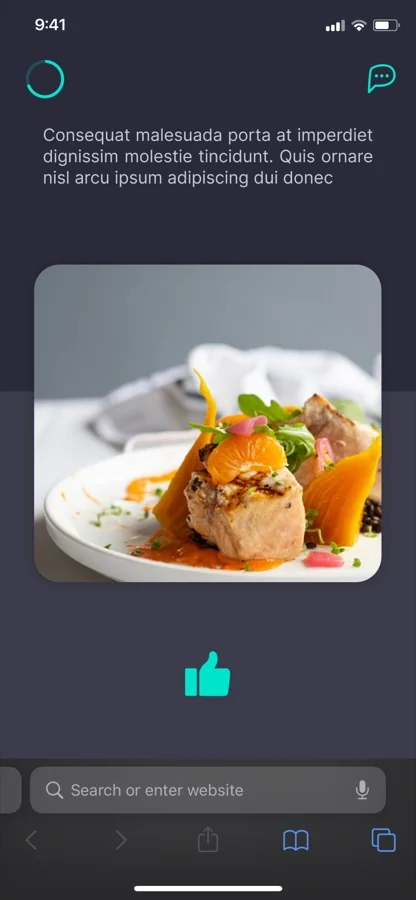
Swipe
Binary preference
06 / Results
What beta changed
Beta ran with real buyers and a live panel, including a client study fielded in March 2022. Four numbers moved (see the cover). Two others were bad enough to change the design.
How the four were measured
- 42 days → 4 hours
- Six weeks was the agency baseline buyers arrived from. A Quick Poll closed in an afternoon.
- 58% → 81%
- First-time buyers completing a brief unaided, before and after construct suggestions shipped.
- 71% → 88%
- Respondent completion. Same questions, same panel: expressive controls against radio buttons.
- 0% → 34%
- Studies launched from a premade or saved recipe rather than a blank build.
65%
Quota detection accuracy
Feasibility became a live reading: reach moves as the audience is described, and a slider trades days against reach, so an impossible quota shows itself while it is free to change.
40%
Recipe relevance
Recommendations had read the objective alone. They were rebuilt to weight entity type too, and known construct pairings joined the suggestions.
Neither was an interface failure. The design absorbed what the engine could not yet do, and that was most of the job.
07 / Carried forward
What I would carry forward
Translate the vocabulary, not the capability
“Quick Poll” and “95%, ±5%” are one object. Hide the second and lose Alex; only show it and lose Jordan.
Say what the machine thinks it heard
An honest amber chip with a way out beats a confident guess.
Separate cannot from should not
Three grades of no, and only two may stop anyone.
Price the choice where it is made
Cost while narrowing an audience is a control. Cost at checkout is an apology.
On a two-sided product, claim the seam
The space between buyer and respondent belongs to nobody unless someone holds it.
- Shipped
- Beta, March 2022
- Surfaces
- Buyer side and respondent side
- Team
- Three designers, two gates, one parity board